


Posted by Rachel Schwartz on 1/5/2021 to
Product Spotlight

Determining the right size mixer for your restaurant, bakery, or business can be a tricky task. If the mixer is too small, it won't perform effectively, and more work will be needed in order to make the same amount of food. On the other hand, if the mixer is too bug then that is money wasted since while a too-large mixer will mix all of your ingredients, it is also more mixer than you actually need.
There are several things to take into consideration when choosing a commercial mixer and size is only one of them. Other important considerations to keep in mind are what items your business makes, how much of those items you make, and whether or not that amount is likely to change in the future. If your business seems to be doing well and steadily growing, then opting for a mixer that may be a little large now but will allow you to scale up operations in the future may be a good option. Likewise, if business is holding steady and you don't foresee needing to rapidly or dramatically increase production, a mixer that fits your current needs might be fine. The goal is to have a mixer that is big enough to hold all necessary ingredients without being filled to the brim. If it is, there is a greater chance that not only will the ingredients not mix together properly but also a greater risk of the mixer's motor being overloaded which is bad for the longevity of the equipment and can result in needing a replacement earlier than expected. Depending on what is being mixed, ingredients can also expand when being combined which can cause an already full bowl to overflow.
In order to help decide what sort of mixers to focus your search on, you first should take a look at the absorption rate of your dough. To find the absorption rate, there is a simple formula: take the weight of the water and divide it by the weight of the flour in your mix. The lower the absorption rate, the harder it will be to mix the dough. For example, pizza dough is a heavier dough and can be harder to mix.
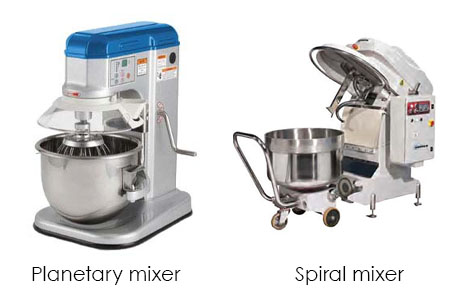
The next point to examine is ease of use. Do you want a mixer with a manual bowl lift, or would an electric bowl lift better suite your kitchen? How many attachments do you need and do those need to be included with the purchase of the mixer or can they be purchased separately? The size of the mixer will also play into this decision but determining ease of use can also help eliminate mixers, leaving you to only look at the varying sizes of mixers with the bowl lift type that you want. Planetary mixers tend to have a manual bowl lift but are more versatile than other mixers in terms of how many different things can be efficiently made using them. They also generally come with several attachments rather than just one. If your business makes a lot of heavier doughs, like a pizzeria, spiral mixers are a good option. Some mixers are even specifically designed for things like pizza. Almost all larger mixers will have an electric bowl lift as the bowl will be far too heavy to lift manually once full of ingredients.
Now that you have determined the kind of dough you make and whether or not a manual bowl lift, electric bowl lift, planetary vs stationary mixer, etc. is your ideal, it's time to look at the size of the mixer itself. From the top of this article, you should have already determined how much you make and whether or not you should consider a larger bowl for future scalability. Now is when you take all of that together and find the best size for your business. Mixers can range from as small as 4 or 5 quart countertop models to upwards of 60 quart floor models. Motor and power of the machine is also included in the size as the bigger the mixer usually, the bigger the motor and the more power.
The 5-8 quart mixers are countertop units that can mix up to 4lbs of bread dough or pizza dough or 1.8 quarts of whipped cream. Because these mixers are small, the motor strength is usually around 1/2 HP. This means that while they can mix harder doughs, they cannot do so for very long without causing damage to the machine.
Ten-quart mixers are a bit larger than the 5-8 quart mixers and can mix up to 5lbs of dough or 2 quarts of whipped cream. Twenty-quart mixers are the beginning of the mid-sized mixers. Still usually countertop units, they are a bit more versatile, have more power, and can mix larger quantities--up to 25lbs dough, 20lbs pizza dough, or 4 quarts of whipped cream.
Floor units start with the 30-quart mixers. These models usually have a motor strength of 3 HP and can mix up to 45lbs dough, 40lbs pizza dough, or 6 quarts of whipped cream. Sixty-quart mixers and above are considered to be large mixers and are designed for businesses that consistently need a high volume of denser doughs. Equipped with very strong motors, they can mix up to 90lbs dough, 70lbs pizza dough, or 60lbs cake batter.
The task of choosing a commercial mixer isn't easy but considering these questions can help narrow down the list of possible mixers appropriate for your restaurant or business's needs without diminishing the efficiency of your production operations.
