


Coffee, one of the most popular drinks in the world and most
people’s preferred choice of caffeine. While there are a ton of different ways
to make coffee (check back for a post on that later), pretty much all coffee in
the world is made from one of four main species of the coffee plant. The coffee
plant itself is a shrub native to the subtropical regions of Africa and Asia
although today, it can be grown throughout Central and South America as well. But
to get to the roasted coffee bean that we are most familiar with, the coffee
plant undergoes a bit of a process.
The berries of the coffee plant are what is harvested before
being peeled apart to reach the seed inside. These seeds are a grey or green
color and are referred to as “green coffee” when at this stage. This green
coffee is what is then shipped and sold around the world as the seeds are
shelf-stable when they are in this state. It’s after this that they are
roasted, ground, and made into the coffee that we pour into our cups each
morning.
As mentioned above, the vast majority of the coffee made
today is derived from just four specific coffee plant species. These are:
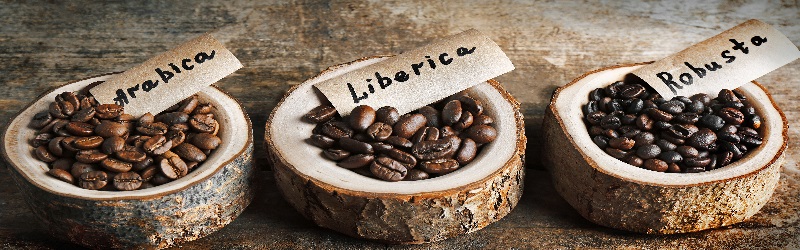
Arabica, Robusta, Liberica, and Excelsa.
Arabica (Coffea
arabica)
By far the most popular, more than 60% of the world’s coffee
production comes from Arabica beans. Despite this, Arabica beans are more
expensive. This may be in part because they are considered to be of a higher
quality or because the plant is more delicate. Arabica plants can be easily
influenced by their environment and are particularly prone to disease. This
means that if one plant becomes diseased, the rest of the crop may quickly
follow as Arabica is often grown in large groups. All of this also means that
growing Arabica can be costly.
Arabica beans tend to have a bright body with just the right
amount of acidity and typically have an intricate layering of different flavors
and aromas. To fully experience this, coffee made with Arabica beans is best
served hot and brewed using either the pour-over or drip techniques. It’s also
a good choice if you prefer your coffee black as adding ice, cream, or sugar
can diminish the quality of the bean.
Robusta (Coffea
caniphora)
The second most popular type of coffee bean is the Robusta
bean. Although Robusta is more acidic and has a harsher flavor than Arabica, it
has several advantages. First, Robusta beans have almost double the amount of
caffeine. Anyone who has trouble waking up in the morning should keep that in
mind. Second, because the Robusta plant is both extremely tolerant regarding
its environment and is almost completely immune to disease, it is much easier
to cultivate making it cheaper and a favorite for the commercial mass-market.
Coffee sold in grocery stores or made to brew at home is, more often than not,
made from Robusta beans. However, because of this mass-market appeal, some
coffee farmers try to get by with sub-standard growing conditions. If you’ve
ever had coffee that tasted rubbery or had an off smell, then you’ve had coffee
that was grown in sub-standard conditions.
High quality Robusta beans should have a smooth texture, low
acidity, and may have hints of chocolate mixed into its flavor profile. And if
you like adding milk or sugar to your coffee, this is the bean for you. Robusta
beans are great for making iced coffee, Vietnamese coffee, or even Espresso
shots.
Liberica (Coffea
liberica)
Although the Liberica bean is hard to find today and makes
up just 3% of the world coffee market, it once saved the world. Well, the
coffee world that is. In 1890, ninety percent of the world’s stock of Arabica
beans were destroyed by coffee rust. To fill the void, the Liberica plant,
grown only in the Philippines, was suggested as a substitute. This worked well
until the Philippines, then a US territory, declared its independence at which
time the US cut off trade and import with the country effectively taking
Liberica beans off the market at the same time. The bean didn’t make another
appearance on the world market until 1995 by which time Arabica plants had
sufficiently recovered and regained their dominance among coffee beans.
With a unique aroma made up of both fruity and floral notes,
Liberica beans are equally unique in appearance as they are larger and
asymmetrical in comparison to their coffee bean peers. They are also the only coffee
beans in the world to have such an irregular shape.
Excelsa (Coffea
excelsa or Coffea liberica var. dewevrei)
Discovered in 1904, Excelsa beans have recently been
reclassified as part of the Liberica family due to their similarities in plant
growth and bean shape. Despite this, many still consider Excelsa to be its own
species of coffee plant. Excelsa’s flavor has been described by many as tart
and fruity while somehow also containing notes reminiscent of a dark roast.
Like the Robusta plant, Excelsa plants have a natural resistance to disease.
Excelsa beans make up around 7% of the world’s coffee production and is mostly
used in blends to give coffee an extra boost of complexity and flavor.
