


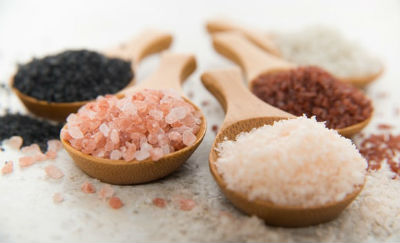
The first thing we must do is realize that salt is not a spice, it should be thought of as a
"flavor enhancer". That said, lets take a look at some of
the specialty salts that are available to the cooks and chefs of today.
The most familiar use of salt undoubtedly is in the kitchen and
on the dining table. Salt accents the flavor of meat, brings out the
individuality of vegetables, puts "oomph" into bland starches,
deepens the flavor of delicate desserts, and develops the flavor of melons and
certain other fruits. No other seasoning has yet been found that can
satisfactorily take the place of salt.
Coarse salt is made up of large-grained salt crystals. Most
coarse salts are best used in a grinder, providing an easy way of serving up
freshly ground sea salt with all of your meals. Coarse salt tends to be less moisture
sensitive than its finer-grained counterparts, so it resists caking and is
easily stored. Use coarse salt to grind over any dish, create a salt crust on
meat or fish, and to flavor soups, stews and pasta.
FINISHING SALTS
Finishing salts are considered the premier varieties in the
world of specialty salts. They are harvested—generally by hand—in special areas
around the world and are known for their unique textures. The various finishing
salt textures—usually either moist crystals or delicate flakes—provide a strong
crunch and dissolve quickly, giving you a burst of clean, mild salty flavor
with each bite. These salts bring out the depth of natural flavors of any dish,
and also add to a beautiful table side presentation. The various colors and
flakes of finishing salts make gorgeous garnishes for every meal.
FLEUR de SEL:
The premier finishing salt, Fleur de Sel literally translated
means “Flower of Salt.” It is harvested from the very top of the salt ponds in
the traditional Celtic methods. This artisan sea salt is comprised of
"young" crystals that form naturally on the surface of salt
evaporation ponds in the Guérande region of France. Paludiers (the salt
harvesters of the Guérande region) carefully rake the salt crystals using only
wooden tools. Just as the cream rises to the top, so does the best Fleur de
Sel. The weather conditions must be just right to produce a good Fleur de Sel
harvest, and the process can only be completed once a year, in the summer.
Called the “caviar of salts” by chefs worldwide, true Fleur de Sel comes from
the Guérande region of France, just like champagne, which must come from the Champagne
region of France to be truly authentic. Also, similar to fine wine regions,
different areas within Guérande produce salts with their own unique flavors and
aroma profiles. Fleur de Sel is ideal for salads, cooked fresh vegetables and
grilled meats.
GREY SALT:
Grey salt is a “moist” unrefined sea salt, usually found in the
Brittany region of France’s Atlantic coast. Its natural light grey color comes
from the minerals absorbed from the clay lining the salt ponds. The salt is
collected by hand using traditional Celtic methods and wooden tools. Grey salt
has gained great fame in the mainstream culinary world in the last few years,
and is considered by many to be the best quality salt available. It is
available in coarse grain – which is the perfect finishing or pinching size,
stone ground fine – ideally used at the table instead of processed salts, and
extra fine (Velvet) grain – perfect for sprinkling over nuts or popcorn.
GRINDER SALTS:
Grinder salts are typically large, dry crystals suitable for a
salt mill or grinder. The large salt crystals are easy to grind in the mills,
and the lower moisture content allows the salt to flow through with little
hassle. Used for flavoring foods at the table when the host determines that a
finer, higher grade finishing salt is not required. Also appropriate for use
during cooking for freshly ground salt flavor.
Note: Always use a salt mill with a ceramic or plastic grinding
mechanism. Metal, including stainless steel, such as is found in pepper mills,
will corrode and/or rust after prolonged contact with salt.
KOSHER SALT:
Kosher salt can refer to two types of salt—one is a specific
shaped flake salt that is so named for its use in the preparation of meat
according to the requirements of Jewish dietary guidelines. It contains fewer
additives, and has a cleaner and more even taste than ordinary table salt. The
flakes dissolve easily, and have a less pungent flavor than processed table
salt. Due to the shape of the granules, there is simply less salt in a pinch of
kosher salt than in a pinch of table salt. This is the kind of salt most often
used on top of pretzels and on the rims of margarita
glasses.
It is important to note that all Kosher salt is not necessarily sea salt.
The second type of Kosher salt is a salt that has been certified
as Kosher by a prestigious organization or certifying body such as the Orthodox
Union, or OU. This means that the salt has met the guidelines of kosher
outlined by Jewish law, and upheld by kosher certification agencies and members
of the Jewish Faith. The certification ensures that the product is produced and
handled in accordance to these high standards, and is suitable for consumption
for those following a kosher diet. All of the Artisan and SaltWorks brand
salts, with the exception of any of the smoked sea salts, have been certified
Kosher by the OU.
I have only begun to scratch the surface of the "gourmet
salts" on the market today. There are some that have spices
incorporated in the salts, ie: oregano and basil, to be used in an Italian
style dish.
The knowledgeable sales staff at J.E.S. Restaurant
Equipment and Kitchen
Emporium can help you decide on your purchase and have
a wide variety of very attractive salt and pepper grinders that also add to
your "tablescape".
Happy cooking,
Chef Phil
